Gold has been one of the most precious materials in jewelry for centuries. However, because pure gold is naturally very soft, it is often alloyed with other metals to increase its hardness, making it suitable for everyday wear. This alloy ratio determines the "karat" of the gold. In the market, 14-karat and 22-karat gold are the most popular choices. So, what are the differences between them, and which one is right for you? Here is a detailed comparison…
What Does “Karat” Mean?
A gold’s karat is a measurement of its purity. Pure gold is defined as 24 karats. Other karat levels are calculated based on this 24-unit scale:
- 14K Gold: Contains 58.5% pure gold.
- 22K Gold: Contains 91.6% pure gold.
The remaining percentage consists of metals like copper, silver, zinc, or nickel, which are added to enhance the gold's durability.
Key Differences Between 14K and 22K Gold
To answer the question, “What is the difference between 14K and 22K gold?” we can look at their distinct characteristics. Let’s dive into the pros and cons of each…
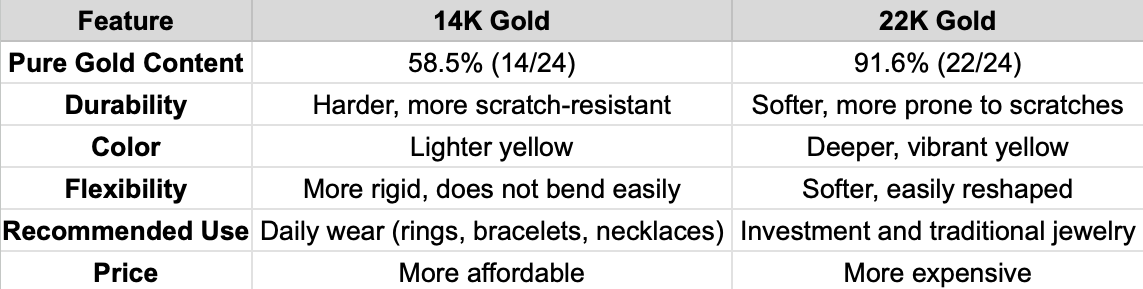
14K Gold: Pros and Cons
Pros:
- Highly Durable: Thanks to its harder structure, it is more resistant to scratches and impacts. Ideal for daily wear.
- More Affordable: Since it has a lower pure gold content, it is more budget-friendly than 22K gold.
- Perfect for Intricate Designs: Its hardness makes it easier to apply complex designs and detailed craftsmanship.
Cons:
- Lower Purity: It is not as high in investment value as 22K gold.
- Subtle Color: It has a lighter yellow hue compared to the deep luster of 22K gold.
22K Gold: Pros and Cons
Pros:
- High Gold Content: Containing 91.6% gold, it is highly valuable for investment and long-term savings.
- Vibrant Color: It features a richer, brighter, and deeper yellow tone compared to 14K.
- Ideal for Savings: Primarily purchased for its value retention over time.
Cons:
- Softer and Prone to Scratches: Due to the high gold content, it may not be ideal for vigorous daily use.
- Premium Pricing: The higher gold volume results in a higher price tag.
- Lower Structural Integrity: In frequently used items like rings, it may lose its shape over time.
Which Karat Should You Choose?
Now that we know the differences, let’s see which type of gold suits your needs best:
- For Daily Wear: 14K gold is the winner due to its hardness. We especially recommend 14K for rings and bracelets that are worn constantly.
- For Investment: 22K gold is the better choice as it retains its value more effectively. Traditional gold bangles (bilezik) are usually preferred in 22K for this reason.
- For Detailed Jewelry: If you are looking for an embroidered or highly detailed design, 14K offers the best structural support.
- For Traditional Pieces: In wedding jewelry, traditional bracelets, and heirloom necklaces, 22K remains the classic and preferred standard.

 EN − TL